
A small tattoo is not only a motif. The same symbol changes when it follows a shoulder, forearm, upper back, collarbone, or thigh. That makes the decision less about finding a clever image and more about deciding where it belongs on your body.
If you arrived from a celestial or butterfly tattoo idea on Pinterest, you are in the right place. This guide takes the next step: choosing the placement, visibility, and scale that can make that direction feel intentional on your body.
From motif to placement
A motif is a direction, not a tattoo to copy. Before bringing one to an artist, decide what you want it to do on your body.
- A round celestial orbit can sit quietly on a shoulder.
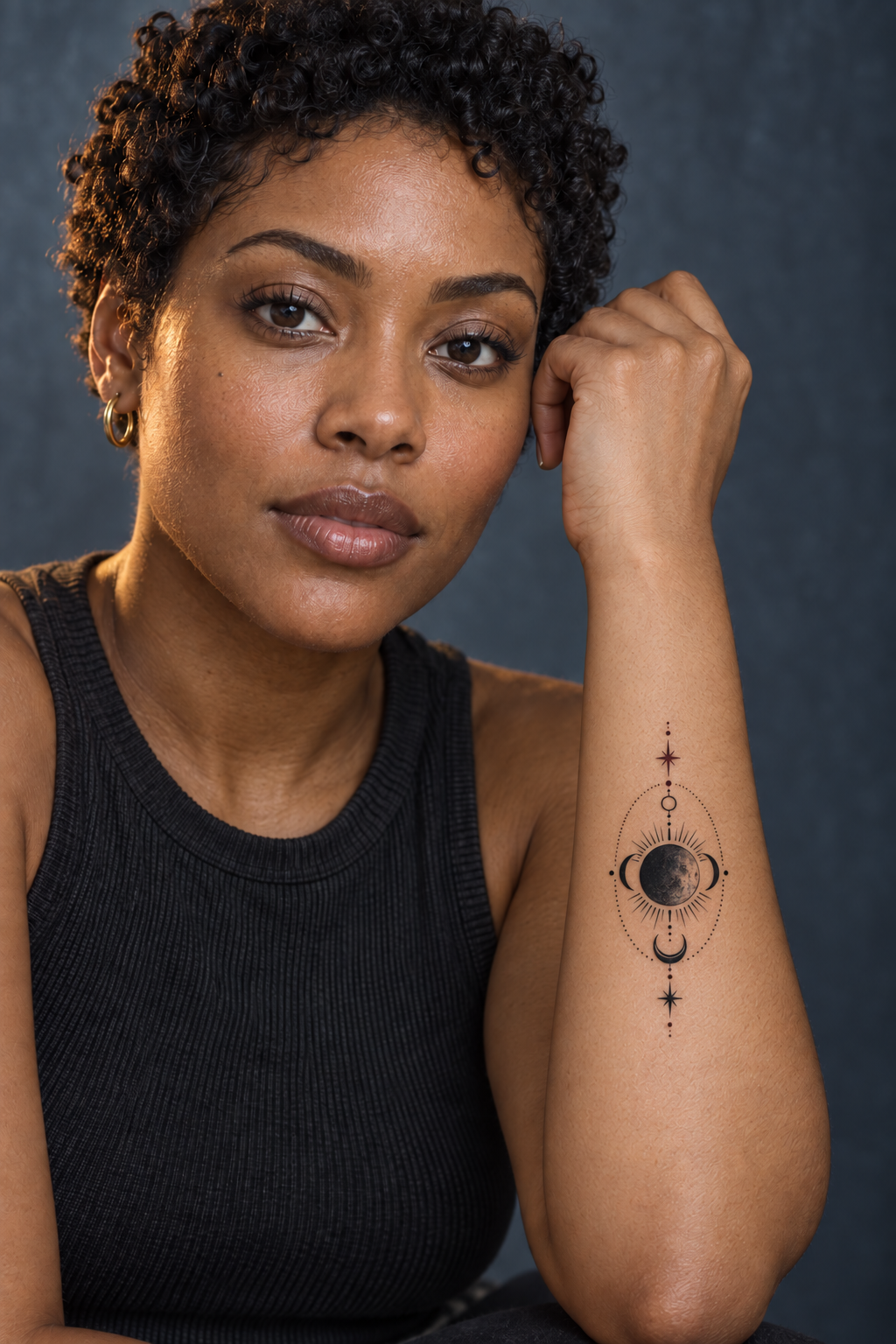
- A compact eclipse can read as a small vertical detail on the forearm.
- A cut-out crescent can feel more private on the upper back.
- A leaf-cut butterfly can hold its shape on the outer upper arm.
- A folded butterfly can become a small collarbone detail.
- A butterfly crossed by one orbit can sit as a contained mark on the outer thigh.
These are starting points, not placement rules. Your artist should advise on the exact scale, flow, and skin area in person.

Begin with visibility
The most useful first question is not “What should it be?” It is “How visible do I want it to be?”
There is a meaningful difference between a motif that caps the shoulder, follows the forearm, sits across the upper back, rests on the collarbone, or moves with the thigh. Scale and movement can change whether a tattoo reads as a private detail, a style signal, or the first thing people notice.
Try writing one sentence for the level of visibility you want:
I want this tattoo to be visible when I choose to show it, but not to lead every interaction.
Or:
I want this tattoo to be a clear part of my appearance, even from across the room.
That sentence gives an artist more useful information than a saved image ever could.
Let the body guide the composition
The body moves. An arm turns, a shoulder rolls, a back curves, and a thigh changes angle when you sit. A motif that looks balanced in a flat reference can feel very different when it follows a real body.
Instead of choosing a final symbol, describe the visual behaviour you want:
- a round design that holds on the shoulder cap
- a vertical system that reads along the forearm
- a compact composition with room to breathe on the upper back
- a motif that follows an existing collection without competing with it
Your artist can then assess placement in person. They can also tell you when a scale that looks restrained on a screen will become too delicate to read over time.
Let one clear construction lead
Tattoos tend to feel strongest when they use one visual rule: one closed orbit, one cut-out crescent, one butterfly structure, one letterform, one short line. Adding extra detail to make the mark “more special” often has the opposite effect. The composition loses its point. Small marks need that discipline especially: they read best when their silhouette and open space do most of the work.
Personal meaning does not need to be obvious to anyone else. A symbol can come from a place, a memory, a date, a fragment of handwriting, or a private association. Bring that source material to the consultation, then let the artist translate it into a design that belongs on your body rather than on a mood board.

Test the feeling before you book
Before a consultation, spend a few ordinary days with the placement in view. A temporary mark or a small makeup dot can help you notice the practical part of the decision: how it feels in a work call, in a shop window reflection, in a family photo, or when you look in the mirror first thing in the morning.
This is not a substitute for your artist’s placement advice. It is a way to notice your own response before the appointment carries momentum.
- Do I still like the visibility when I am not styling around it?
- Does this placement feel like me, or like an image I liked for a week?
- Would I be comfortable describing the choice to an artist without relying on a trend reference?

Choose an artist for more than the motif
Look for healed work, line control, and compositions that sit naturally on the body. It is especially helpful to find an artist whose work shows restraint: clear marks, considered spacing, and an understanding of how a tattoo will read at the scale you want.
When you contact them, send a short brief rather than a collage of finished tattoos. Include:
- your personal source or meaning
- the visibility level you want
- the general placement area, not a fixed drawing
- a few style words, such as soft blackwork, fine line, graphic, or ornamental
- what you do not want, such as lettering, symmetry, or heavy shading
That leaves room for the artist to make an original composition.

Give the decision enough time
A tattoo can be meaningful, playful, direct, discreet, or all four. It can also feel completely different once it moves with your body and appears in everyday clothing. Giving yourself time is not indecision; it is part of treating a permanent mark with care.
Save your source material, refine the sentence that describes the visibility you want, and sit with it long enough to separate the idea from the urgency. If the direction still feels right, you will arrive at the consultation with something far more useful than a copied tattoo: a clear point of view.

A simple tattoo-placement brief
Save the motif study that spoke to you, then use this as a starting note for your artist:
I am considering a tattoo on my [shoulder / forearm / upper back / collarbone / thigh]. I want it to feel [discreet / clearly visible / graphic / soft]. The personal source is [memory, object, place, or idea]. I am drawn to [style words], but I do not want [elements to avoid]. I would like your advice on scale, flow, and exact placement for my body.
FAQ
What makes a tattoo feel deliberate?
Scale matters, but so do contrast, placement, and construction. A full motif can feel deliberate when it has a clear silhouette and enough open space; a smaller mark can still dominate if it lands on a high-contrast area. Your artist can help you judge it in person.
Should I bring a finished tattoo design to my artist?
Bring references for visual direction and personal source material, not a finished design to reproduce. A good brief gives the artist room to create an original piece for your features and placement.
How do I know if I am ready?
You may be ready when you can describe the visibility, placement area, meaning, and style direction without needing one exact online image to make the decision for you.