30 butterfly tattoo ideas with meaning and placement notes
If you have saved a pile of butterfly tattoos but still cannot tell which one belongs on your body, more references will not solve the problem. You need a direction an artist can interpret: a shape, a personal source, a placement and a short list of details worth keeping.
The 30 original motifs below are planning references, not finished tattoos. Each one gives you a construction idea, a possible personal association, a placement direction and one feature to protect when your artist redraws it.
Save the full reference sheet for your consultation. You may use it for personal planning and discussion with your tattoo artist. It is not a stencil, a finished commission or a license for resale. Ask your artist to rebuild the motif in their own drawing language and fit it to your body.

Read the sheet from left to right, starting at the top. The numbers in this guide follow that order.
How to choose a butterfly motif without copying someone else's tattoo
A useful reference tells an artist what you like without asking them to reproduce someone else's work. Start with four decisions:
- Pick a posture: open, folded, turning, rising or resting.
- Pick the part that carries your story: the outline, a wing division, a break, a plant structure or a colour block.
- Name the placement shape: narrow vertical, gentle arc, compact oval or wide horizontal.
- Decide what may disappear if the design needs to become smaller.
Do not begin by collecting tiny symbols to place inside the wings. A butterfly needs a readable outer shape before it needs decoration. When the silhouette is generic, more stars, flowers and dots usually make the brief busier rather than more personal.
For a quick first pass, choose one motif with the right body flow. Then mark the single feature that carries your story and the first detail you would be happy to lose at a smaller size.
If meaning is your main question, read our butterfly tattoo meaning guide. It explains how to turn memory, change and an unfinished next chapter into a clearer artist brief.
Motifs 1 to 10: movement and organic structure

1. Continuous ribbon flight
A single looping line draws the wings and then leaves the body as a loose route. The open loops can suit a story about movement, return or a path that still feels unfinished. Its narrow vertical rhythm can work along an inner forearm, above an ankle or behind the upper arm. Protect the long outer loop and remove secondary crossings first.
2. Folded swallowtail
Seen from the side, this butterfly has one dominant upper wing and a hooked lower tail. It feels alert rather than decorative, which can suit a person who wants change to look active rather than gentle. The slim profile follows a forearm, calf or rib curve more naturally than a wide open-wing butterfly. Keep the outer tail and one strong interior band.
3. Soft asymmetric ribbon
The two wings do not match. One rises while the other folds into a long ribbon. That imbalance can suggest adaptation, a life that changed shape or two parts of a story that do not carry equal weight. Try it on the shoulder blade, outer upper arm or side ribs. Protect the unequal wing span; the trailing loop is optional.
4. Shattered line burst
Broken angular marks interrupt a familiar butterfly outline. It may connect to disruption, a sudden turn or rebuilding after a break, but the wearer should define that association in their own words. The compact diamond-like silhouette suits the upper arm, back of the shoulder or thigh. Keep the main four wing points and limit the loose fragments.
5. Upward side flight
Both wings lean in one direction, so the butterfly appears to climb instead of sitting flat. Choose this when the story needs forward motion without adding an arrow. It can follow the collarbone, rise beside the ribs or sit diagonally above the ankle. The upward angle matters more than the fine wing veins.
6. Fern frond wings
Paired fern structures replace conventional wing cells. They can point to a real garden, trail or plant memory while keeping a clear butterfly body at the centre. The motif needs enough room for the fronds, so test it on a shoulder blade, upper arm or outer thigh before shrinking it. Keep the main frond stems and reduce the smallest leaflets.
7. Moon-cell moth
Four restrained circular cells sit inside pointed, leaf-like wings. It could fit someone whose personal reference involves a repeated circle, a night routine or a specific object with round details. A compact upper arm, calf or shoulder placement gives the circles room to stay separate. Protect the four cells; remove tiny orbiting marks if they crowd the drawing.
8. Ginkgo fan
Ginkgo-like fans create broad wings with strong edges and very little internal clutter. The shape can recall a tree, a city street, a family garden or the fan rhythm of the leaves. Its horizontal spread suits the shoulder blade, sternum area or outer upper arm. The scalloped fan edges are the identifying feature.
9. Thorn frame
Thin thorned branches define the wings rather than filling them. This can suit a story where protection, boundaries or difficulty belongs in the structure instead of appearing as a separate symbol. The tall, narrow shape can fit the back of the upper arm, forearm or calf. Keep the four angular outer points and use fewer thorns at small scale.
10. Iris petal wings
Four soft petals form a butterfly without drawing a flower beside it. Use this direction when one specific bloom matters but a literal bouquet feels too obvious. A shoulder cap, upper back or side-rib placement can support the broad, falling petals. Protect the petal silhouette and one central fold per wing.
Motifs 11 to 20: contrast, repair and naturalist studies
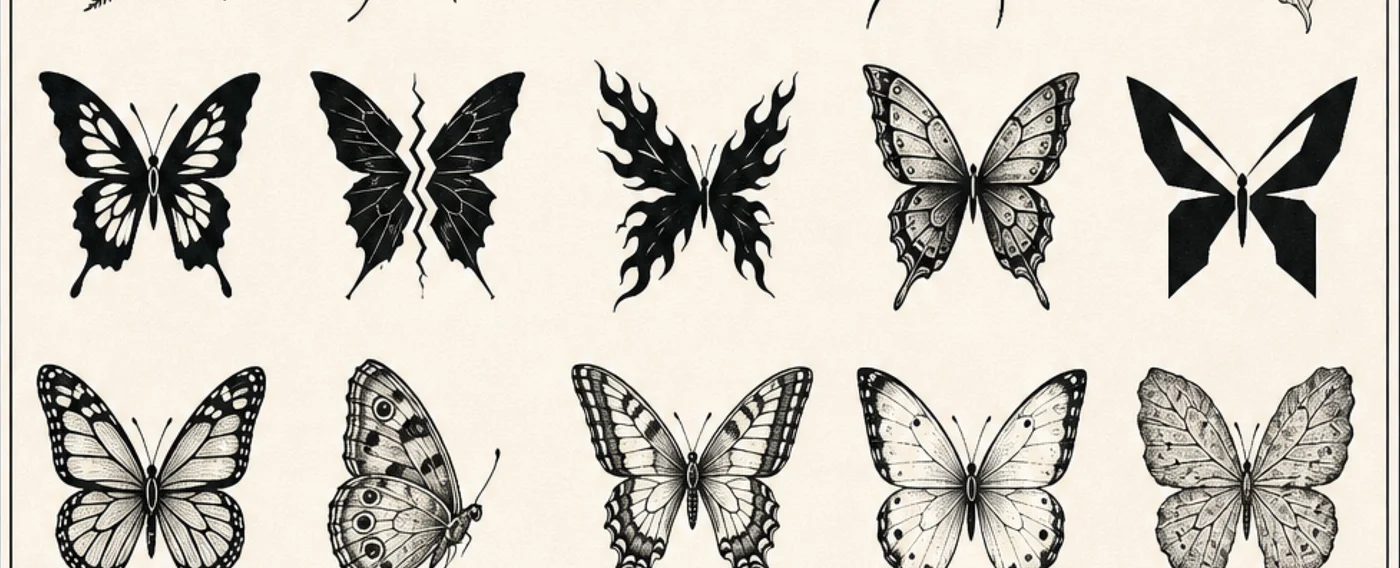
11. Negative-space blackwork
A dark butterfly holds large open windows inside the wings. Choose this direction if you want a small piece with a firm silhouette and very little fragile linework. It can work on the upper arm, calf, shoulder blade or thigh. Protect the open windows and the outer lower-wing drops; avoid filling every black area with texture.
12. Repaired split
A clean break divides the butterfly into two halves, with a narrow irregular seam between them. It can mark repair, separation or a change that remains visible. The balanced vertical shape works on the spine, sternum area, forearm or calf. Keep the gap wide enough to read; the small internal crack lines can disappear.
13. Flame edge
The wing edges rise into controlled flame-like points while the butterfly body stays simple. It may suggest intensity, anger, energy or a chapter that changed quickly. It needs an open field such as the outer upper arm, shoulder blade or thigh. The flame contour carries the concept, so reduce interior shading before softening the edge.
14. Engraved jewel
Panelled wings use a restrained engraved texture and a few bead-like cells. The motif can connect to an heirloom, a decorative object or a love of old printed illustration without copying a historical plate. Try it at a medium scale on the upper arm, calf or shoulder blade. Preserve the large panels and one texture direction; skip miniature filigree.
15. Geometric block butterfly
Four solid polygonal wings create a severe, modern silhouette. It is an alternative for someone who likes the butterfly idea but not its usual softness. The compact form can sit on a forearm, upper arm, calf or shoulder. Protect the negative angles between the blocks and keep the body uncomplicated.
16. Naturalist open wing
The first naturalist study uses bold marginal spots and a clear vein map. It works best when a real species or field-guide reference matters to the wearer. A shoulder blade, upper arm or thigh gives the wing pattern room to breathe. Keep the main border, two or three species cues and the body proportion.
17. Resting side view
One closed wing shows layered eye spots and a folded lower edge. The quieter posture can fit remembrance, observation or a pause rather than a transformation narrative. Its vertical oval shape suits the forearm, calf or ribs. Protect the outside profile and the largest eye spot; simplify the small rings.
18. Swallowtail field study
The long lower tails and striped upper margin give this butterfly a recognisable rhythm at a glance. It can be personalized through one species reference, a location or a date kept outside the drawing. Use a wider placement such as a shoulder blade, outer upper arm or thigh. Protect the tails and top border before the inner cells.
19. Pale glasswing
Large open wing fields are held by a dark edge and a few measured marks. The empty areas can support a story about lightness, space or something deliberately left unsaid. It may suit the upper arm, back of the shoulder or rib side. Keep the dark perimeter and central body; let the open fields remain open.
20. Pressed-leaf butterfly
The wing surfaces carry leaf-like veins and a slightly weathered edge. This can come from a pressed leaf, a seasonal memory or a plant found in a meaningful place. The rounded silhouette suits the upper arm, shoulder blade or outer thigh. Protect the primary vein and the uneven edge, not every small branch.
Motifs 21 to 30: geometry, orbit and controlled colour
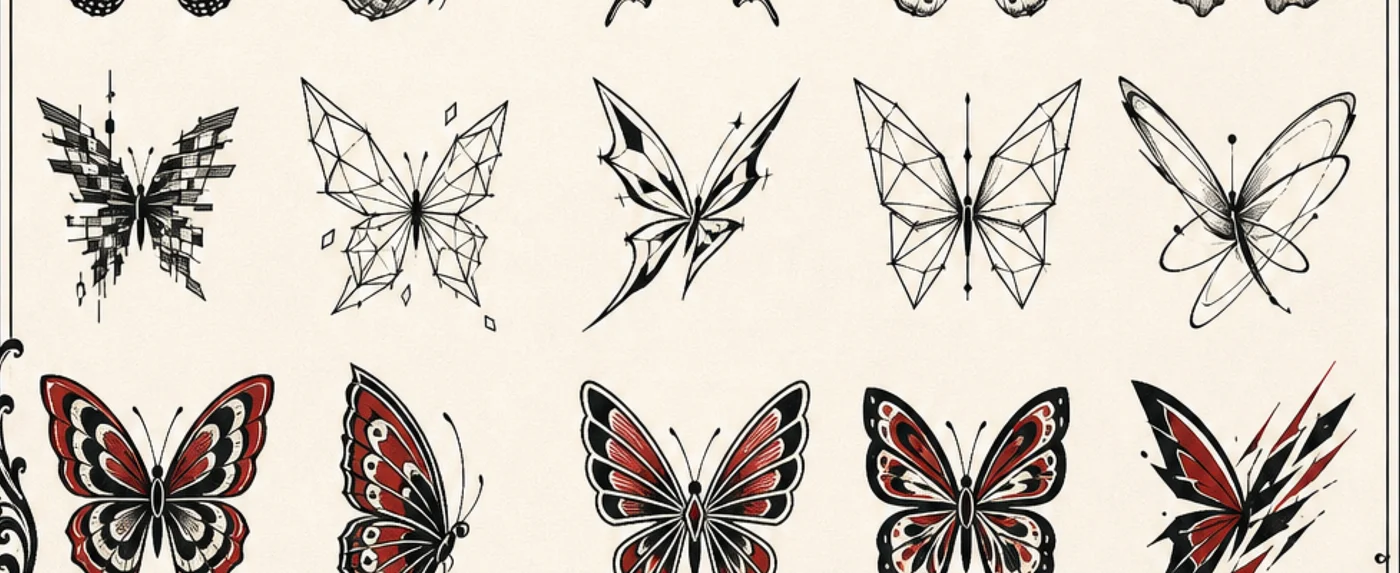
21. Glitch window
Rectangular interruptions cut through the wings like a broken signal or a city seen through fragmented panes. This can suit a digital memory, a disrupted routine or a person who prefers abstraction to traditional symbolism. The broad structure works on an upper arm, calf or shoulder blade. Keep three or four large interruptions and remove the smallest bars.
22. Crystalline lattice
Faceted lines build the wings from irregular polygons. A personal association might come from a broken object, architecture or the idea of finding order after a fracture. The shape reads well on the forearm, calf or upper back when the facets stay open. Protect the outer polygon and a few large divisions; tiny shards are unnecessary.
23. Spear wing
Long pointed wings cross like drawn blades, giving the butterfly a fast directional posture. This can connect to decisiveness, defence or a sharp change in direction. Its narrow diagonal suits the ribs, outer forearm or shoulder. Keep the crossing angle and longest points; simplify the small inner cuts.
24. Folded geometry
A symmetrical butterfly is divided into large triangular planes with a strong vertical axis. It can suit someone who wants calm structure rather than soft ornament. The design can fit the sternum area, spine, calf or inner forearm, depending on scale. Protect the central axis and six or seven large planes.
25. Orbital line butterfly
Loose ellipses pass around a simple butterfly body and partly replace conventional wing boundaries. The orbit can come from a personal route, repeated return or interest in motion rather than generic celestial symbolism. It can wrap lightly along the forearm or upper arm. Protect one clear ellipse and the butterfly body; too many crossings will blur at small scale.
26. Red and black folk wing
Bold scalloped wings use red as a controlled internal rhythm rather than a soft wash. The direction can draw from the wearer's own textile, print or family object if they have the right to use it. It suits the upper arm, calf or shoulder blade. Keep the black outline and two repeated red shapes; remove filler decoration first.
27. Red side profile
A side-view butterfly pairs a black edge with a few red eye-like cells. It feels mobile and compact, making it useful for a forearm, ankle, calf or rib placement. The personal connection should come from the chosen colour source or species, not a universal colour meaning. Protect the profile, lower tail and one red cell.
28. Art deco wing rhythm
Stacked black and red bands create a formal, architectural butterfly. It can suit a memory tied to a building, theatre, poster or piece of jewellery without placing that object beside the insect. A balanced upper arm, shoulder blade or calf placement supports the symmetry. Keep the major bands and central diamond; remove minor repeats when scaling down.
29. Compact traditional block
Heavy black borders and restrained red shapes create a sturdy, readable butterfly. This direction works for someone who wants a small motif that still has visual weight. It can fit an upper arm, calf, outer forearm or shoulder. Protect the thick perimeter and the simplest red fields.
30. Fractured red flight
The final motif breaks one moving butterfly into sharp black and red fragments. It can mark acceleration, rupture or a choice that did not unfold neatly. The diagonal shape follows the shoulder, ribs or outer forearm. Keep the main wing wedge and direction of travel; reduce loose shards before making the core smaller.
Compare placement by shape, not by trend
The most useful placement question is not "Where do people put butterfly tattoos?" It is "What field does this drawing need?" Use this table to narrow the first stencil test.
| Motif shape | Directions in this guide | Placements worth testing | Main risk at small scale |
|---|---|---|---|
| Narrow vertical | 1, 2, 9, 17, 23 | Inner forearm, calf, ribs, back of upper arm | Wing layers closing together |
| Wide horizontal | 6, 8, 10, 16, 18 | Shoulder blade, upper back, outer thigh, shoulder cap | Shrinking the body until it disappears |
| Compact oval | 7, 11, 15, 19, 20, 29 | Upper arm, calf, outer forearm, shoulder | Tiny interior cells becoming noise |
| Strong central axis | 12, 14, 24, 28 | Spine, sternum area, forearm, calf | A narrow centre gap merging into one line |
| Diagonal movement | 3, 4, 5, 13, 21, 22, 25, 27, 30 | Collarbone, ribs, shoulder, outer forearm | Losing the angle that creates motion |
These are planning directions, not promises of fit. Ask the artist to test the stencil while you stand naturally. A drawing that looks balanced on flat paper may need a different tilt, width or gap once it wraps around the body.
A practical small-size test
Print the motif at the approximate size you are considering. Then make a second copy with all texture, dots and minor cells removed. Compare both at arm's length.
Keep the outer wing shape, body angle and one main interior division. If the butterfly becomes unrecognisable without tiny detail, the construction needs work. If the silhouette still reads, the artist can decide which texture belongs at the final size.
Avoid choosing an exact centimetre measurement from a screen. Phone size and zoom make a drawing look larger than it is. Use a ruler, print more than one size and let the artist adjust the stencil for the placement.
Write a brief an artist can use
Choose one of the 30 directions, then write a short note using this structure:
- Motif number and the part you want to keep
- The personal source behind it, such as a plant, route, repaired object, building detail or species reference
- Preferred posture and direction of movement
- One placement to test and one alternative
- A rough size range, measured on your body
- The first detail you are willing to remove
- Two examples from the chosen artist's own portfolio that show suitable line weight or spacing
For example: "I like motif 12 because the open repaired split matters more than the wing texture. I want a narrow vertical version for the inner forearm, roughly 6 to 8 cm for testing. Please keep the gap readable and redraw the wings in the line weight you use for similar work."
That tells an artist what you value while leaving the final composition in their hands.
Questions people ask about butterfly tattoo ideas
Are these butterfly motifs free to use?
You may save the sheet and use it as a personal planning reference with your tattoo artist. Ask the artist to redraw and adapt the motif for your body. Do not resell the sheet, upload the motifs as your own flash or distribute them as a design pack.
Which butterfly design works best as a small tattoo?
Start with motifs that have a strong outer shape and few interior divisions. Numbers 1, 5, 11, 15, 19, 24 and 29 give an artist a clearer small-scale structure than motifs built from many leaves, facets or engraved cells. The final choice still depends on size, placement and the artist's method.
How can I make a butterfly tattoo feel personal?
Change one part of the construction using a source from your own life. A plant vein can replace a wing division. A repaired seam can define a break. A familiar doorway can shape one open cell. The personal source should change the drawing rather than sit beside it as another tiny symbol.
Do butterfly tattoos have to mean transformation?
No. Transformation is a common association, not a rule. A butterfly may connect to a person, place, species, season, memory, visual style or private event. Write your own association in one sentence before deciding which motif supports it.
Where should I place a butterfly tattoo?
Match the silhouette to the body area. Wide open wings need a broad field. Folded and side-view butterflies suit narrow areas. Turning and fragmented motifs can follow a diagonal or curved placement. Compare paper cut-outs or temporary stencil tests before deciding.
Can I ask an artist to copy one of these motifs exactly?
Use the sheet as a direction, not a demand for an exact copy. A tattoo artist needs to account for scale, anatomy, line spacing and their own method. Point to the feature you care about, then give them room to redraw it.
Save the sheet, then make one decision
Do not merge five favourites into one butterfly. Circle the motif with the strongest outer shape for your placement. Mark the single feature that carries your story. Cross out the detail you would remove first.
Bring that edited reference, a placement photo and one personal source to the consultation. It gives your artist something clear to respond to without asking them to copy a finished design.