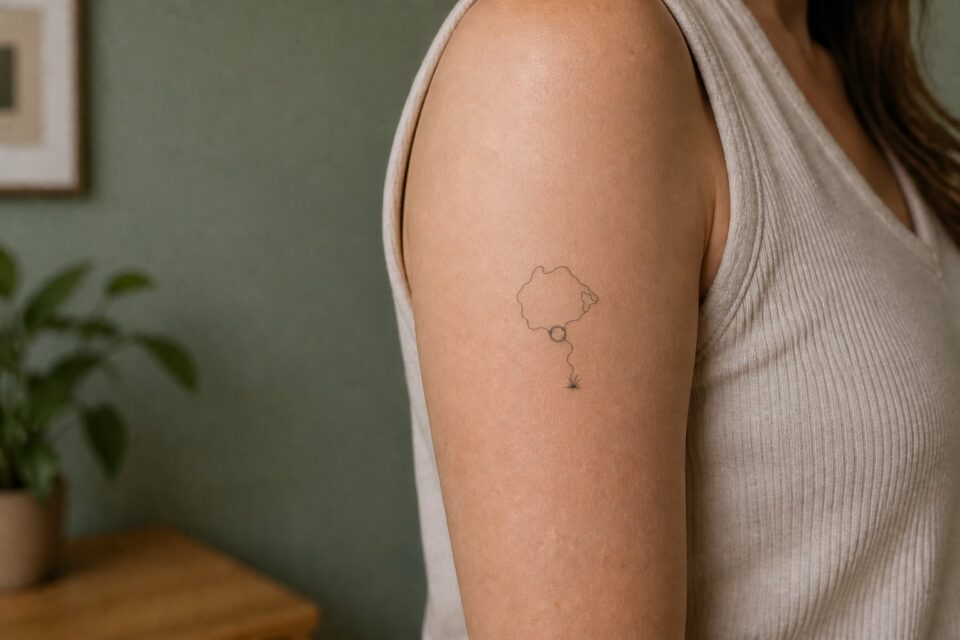

A family tattoo can represent connection without listing names, initials, or birth dates. Everyday objects, repeated routines, home details, plants, tools, recipes, routes, and private visual systems may hold a more complete version of family life.
Find the shared source
List the places where family time happened and the ordinary objects that appeared there. Think about table shapes, garden plants, doorways, fabric patterns, inherited tools, handwriting, weather, and sounds. Ask other family members what they remember; different answers can reveal the most durable shared details.
Choose a source that can remain meaningful as roles and relationships change. A home object may represent care across generations without fixing each person to one permanent label.
Use the animals that shaped family life
A cat and dog do not need to appear as two complete portraits. Their different ear shapes, sleeping positions, tags, bowls, or favourite places may describe the household more honestly. If several pets are involved, give each one a feature with equal emotional weight rather than equal physical size. A small toy can represent one animal while a compact silhouette represents another.
Ways to organize several relationships
One source with several details
A plant can contain different leaves, a house can contribute separate architectural lines, or a recipe can become several tools. Hierarchy keeps the design from becoming a row of equal icons.
A repeated rule
A count, interval, dot, angle, or frame can represent people without displaying initials. Keep a private key if the system matters to you.
Related but individual pieces
Family members can choose separate subjects drawn in one visual language. The relationship lives in treatment, scale, or a small repeated mark, not exact matching.
A place-based composition
A window view, map bend, porch line, mountain contour, or garden plan can locate the family story. Simplify the source with the artist instead of copying a map screenshot.
Leave room for family change
Consider whether the design can hold births, deaths, chosen family, separation, and new relationships without requiring constant additions. An expandable pattern may suit some stories; a symbol for the family’s shared foundation may suit others.
Avoid ranking people through size or position unless hierarchy is deliberate and comfortable. Explain the emotional structure to the artist instead of asking them to infer it from a list.
Build the brief
- The family story or value at the center
- The shared place, object, or routine
- Who or what needs representation
- Whether the system should be readable or private
- How much future change the design should accommodate
- Placement, visibility, and style preferences
The goal is not to fit every family fact into one small tattoo. It is to identify the source that makes those relationships feel like one story.
Start with the detail your family actually shares
Generic family symbols are easy to find, but a better starting point is usually a detail that already belongs to your group. Ask each person to write down a routine, object, place, meal, phrase, or small story they associate with the family. Compare the lists without trying to turn them into tattoos yet.
The overlap may be ordinary: a fruit tree in a grandparent’s yard, a game played on long trips, a cup always kept in the same kitchen, or the outline of a familiar coastline. Ordinary details often make strong private symbols because they do not need to explain themselves to everyone else.
If several people want related tattoos, they do not have to be identical. Keep one shared element and let size, placement, or surrounding details change for each person. That allows someone who likes bold work and someone who prefers a quiet design to participate without either wearing a compromise.
Before settling on the image, have everyone describe what it means in one sentence. If the answers are completely different, that may be fine, but it is worth knowing. The aim is not a symbol that looks “family-like.” It is a design that brings the same specific memory back when you see it later.
Describe the family system, not only the family tree
Who shows up, who cooks, who calls, who teaches, who makes room, and who remembers? Family can be biological, chosen, blended, adoptive, distant, changing, or complicated. Begin with the action that makes these people family rather than forcing everyone into a traditional tree diagram.
A design can honour care without pretending every relationship is equal. One object may represent a household; separate marks may acknowledge people with different roles. You control how much of that structure needs to be visible to strangers.
Search the family archive for shapes
Recipes, tools, furniture, garden plants, house numbers, textile patterns, maps, handwriting, and photographs of rooms all contain usable forms. Look at the background and edges. The curve of a table or repeated tile may trigger recognition more directly than a generic family emblem.
Record who owns each source and ask permission when it comes from private correspondence or a culturally specific object. Keep names, addresses, and full documents out of public reference boards unless everyone involved agrees.
Handle counts without making a census
Dots, petals, stars, branches, and birds are often used to count family members. Decide whether the number must remain fixed. Families grow, separate, reconcile, and redefine themselves. An open composition, expandable rhythm, or symbol for a shared place may carry change better than a closed row.
If the count is fixed because it marks a particular chapter, say so. The tattoo does not have to update every time life changes. Honest time boundaries are better than pretending a number is universal and permanent.
Use related forms for different people
Different flowers from one garden, tools from one kitchen, windows from the same house, or bends in one route can represent individuals without ranking them. Keep a repeated line, scale, frame, or direction to hold the group together.
Let one person remain private
Not every family member needs a labelled symbol. A gap, hidden initial, colour, or internal mark can carry someone whose story you do not want to explain. Privacy can be part of the composition rather than a missing detail.
Edit the number of visual ideas before shrinking
A house, tree, six flowers, three dates, and a quotation will not become delicate merely by reducing the whole collage. Choose a visual leader and one supporting system. If more stories deserve space, consider separate tattoos or a larger composition planned over time.
Print the design at size and check whether every counted element remains distinct. Ask the artist how to preserve hierarchy and leave enough open skin. A larger piece with breathing room may look gentler than a crowded small one.
Respect family consent without giving away body autonomy
Relatives may have opinions about shared words, memorial material, or who is represented. Listen and obtain permission for private sources where appropriate. You still make the final decision about your body, placement, and how much explanation the piece offers.
Avoid surprising someone with a portrait, signature, or sensitive story posted publicly. The tattoo can be personal without becoming public family documentation.
Give the artist a relationship map
Write the family action, personal source, fixed count if any, people or details that must remain private, placement range, and the feature that connects the composition. Add relevant work from the selected artist’s portfolio.
The final design does not have to tell strangers who everyone is. It should bring you back to the particular way this group made a home, carried a habit, or shaped your life. Recognition inside the family is enough.
Decide whether the design must be expandable
If future children, partners, chosen family, or reconciliations may be added, tell the artist now. Expansion works best when built into rhythm or open space, not when another tiny symbol is squeezed into a closed composition. Ask where a future element could join and what size it would require.
It is also valid to make the tattoo a dated portrait of the family as it existed in one chapter. Write that boundary in the archive. A fixed design does not exclude future people; it records the group and care that shaped that particular moment.
For an expandable version, reserve a visual rule rather than a literal empty box. Future additions might repeat a leaf angle, object scale, frame shape, or path rhythm. Ask the artist to document the rule and photograph the completed piece in neutral light.
Do not promise that another artist can extend custom work later without consultation. Keep the original artist’s information and ask about future availability or permission. Expansion should respect authorship as well as family change.
Leave a plain written key in the private archive explaining what each current element represents and which parts are intentionally open. Future you may remember the feeling but forget the exact count or source. The key prevents later additions from being based on a mistaken reconstruction of the first design.