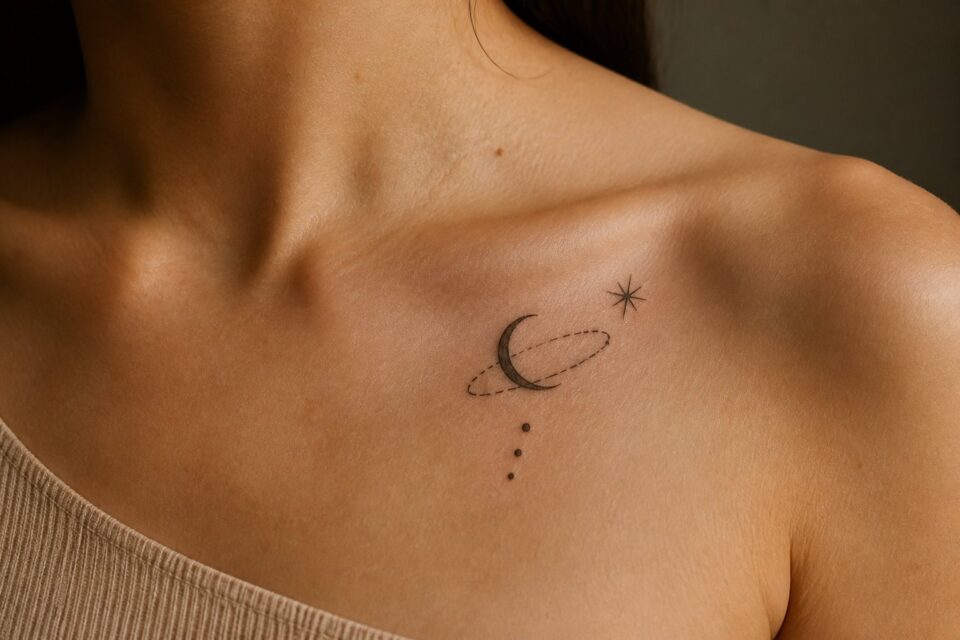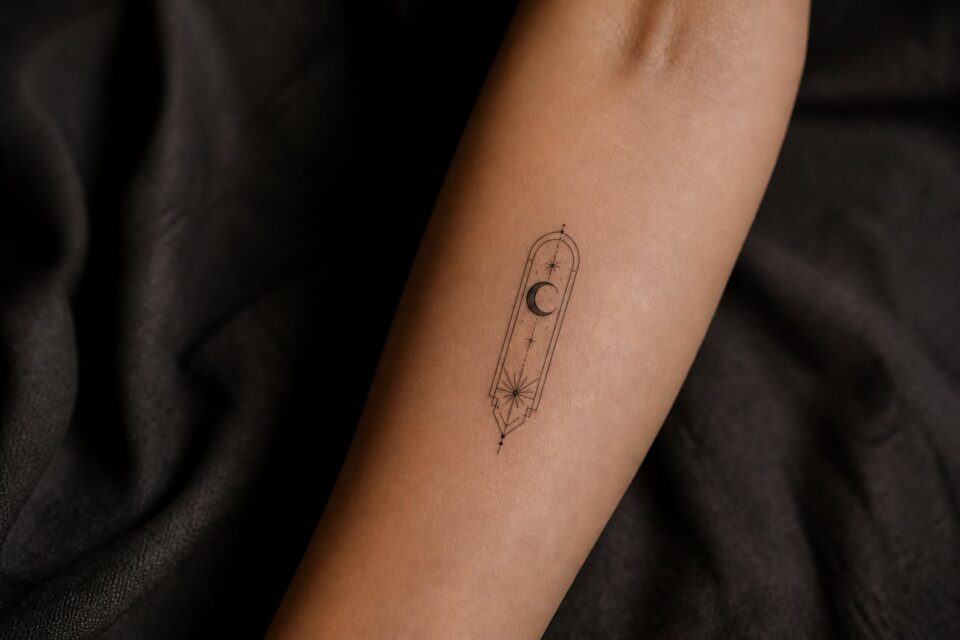
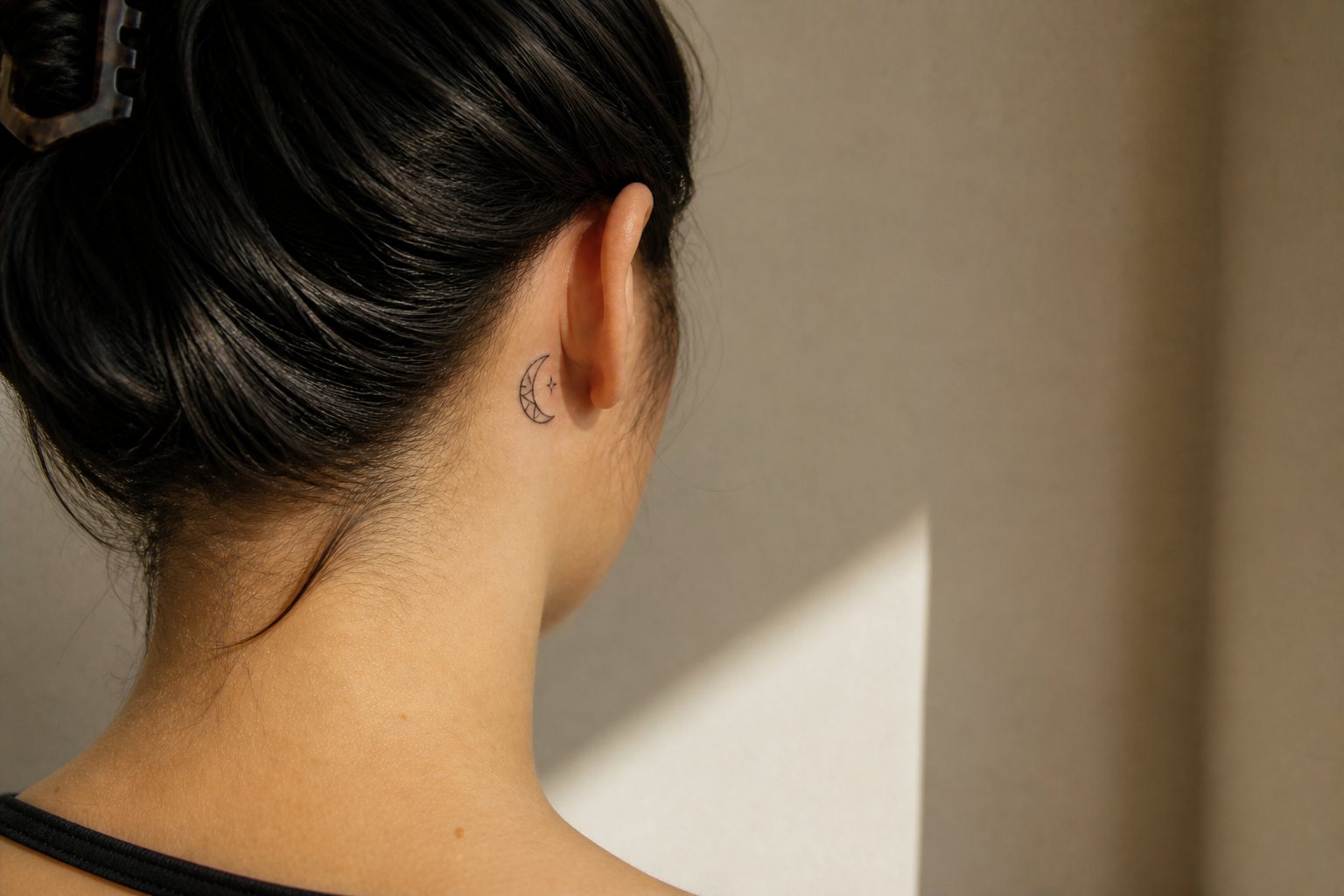
The area behind the ear is visually small but not featureless. The ear, hairline, jaw, and neck create a narrow piece of negative space that can suit a crescent, star, orbit, or another small celestial mark. The design should respond to that shape instead of becoming a reduced version of a large sky scene.
Read the space before choosing the subject
Look at the area with hair up and down, from the side and slightly behind. Decide whether you want the design to follow the curve of the ear, descend toward the neck, sit as a compact mark, or appear only from certain angles.
Celestial shapes that naturally fit a narrow placement
A short vertical gesture
A falling star, a narrow moon-phase pair, a short comet tail, or a vertical trail of two or three points can use the available height without requiring a wide composition.
A compact silhouette
A simplified crescent, solid star, small sun disc, or ringed planet can work when the subject remains readable after unnecessary detail is removed.
A curve that responds to the ear
A crescent, eclipse arc, or loose orbital line can echo the anatomy without outlining it literally.
A tiny constellation fragment
Two or three points from a personally meaningful sky pattern may suit the idea, but the artist should determine whether the intended size keeps the spacing clear.
Questions to bring to an artist
- What size allows this subject to remain legible?
- Should the design face toward the ear or the neck?
- How will the placement look with my usual hairstyle or eyewear?
- Does your portfolio include comparable small-scale work?
- Which details would you simplify first?
Plan how the tattoo enters and leaves view
Hair length, eyewear, jewelry, posture, and camera angle can change how often a behind-the-ear tattoo appears. Decide whether the design should be fully visible from the side, discovered only from behind, or partly covered in everyday life.
Use orientation deliberately
A crescent can open toward the ear or neck. A stem can rise, fall, or follow the curve. Lettering can face different viewers. Ask the artist to place several paper versions so the relationship to the ear is considered before the stencil is fixed.
Edit the subject for the space
Choose the one contour or gesture that makes the subject recognizable. A wide constellation, complete moon-phase row, or detailed planetary scene may need another placement. Moving the idea is sometimes a better solution than reducing it further.
- Bring photographs with hair worn in typical ways.
- Note glasses or jewelry that affect the visual area.
- Ask what scale supports the chosen detail.
- Review comparable work from the artist’s portfolio.
- Keep health questions separate from visual planning.
The placement works best when the design responds to a narrow, changing frame without pretending it is a small flat canvas.
Check what the placement hides and reveals
Behind-the-ear tattoos shift with hair, glasses, earrings, and the angle of the head. Tape a small paper outline in place and take photos with your hair up, down, and tucked back. Include your usual glasses or jewelry so the test reflects everyday life.
View the placement from a few steps away. At that distance, a clear silhouette matters more than tiny interior details. A narrow crescent, solid star, short comet, or simple orbit may remain legible, while several separate fine points can blend into one patch from across the room.
Move the outline slightly toward the hairline and then slightly toward the jaw. The first option may feel more private; the second may show more often. Also check whether the design appears level when your head is relaxed, not tilted to expose the area.
Bring the photos to the artist and let them judge what their line work can support at the proposed size. The placement is small, but the decision does not have to be rushed.
“Behind the ear” includes several different zones
A mark can sit directly in the small hollow behind the ear, drop toward the upper neck, or travel along the hairline. Those positions differ in available space and how often the tattoo appears. Bring a photograph of your own ear and hairline to the consultation, then let the artist examine the area in person. A placement copied from someone with a different ear shape may not translate cleanly.
Use a mirror to notice what remains visible when your head faces forward. A design that looks centred in a side-view photograph can disappear behind the ear from most everyday angles. That may be exactly what you want. Decide whether the piece is meant as a hidden detail, a side-profile accent, or part of a larger neck or hairline composition.
Bring your real hair and jewellery routine into the decision
Try the placement with hair up, hair down, glasses, headphones, earrings, and any hearing device you use. Photograph each version. A hoop or earpiece may visually collide with a small symbol even when there is no physical overlap. An artist can shift the stencil or change its direction once they understand the objects that regularly frame the area.
Do not style yourself only for the appointment photo. If you almost always wear your hair loose, assess the tattoo that way. If a workplace or family setting affects visibility, test your normal styles rather than assuming this placement is automatically discreet.
Choose a silhouette that reads in a narrow space
The area rewards celestial designs with a clear outer shape: a crescent, solid star, small sun, curved orbit, compact planet, or short meteor trail. Subjects with many crossing lines or several equal focal points can become hard to understand when reduced. Ask which one or two features make the subject unmistakable and allow the rest to be simplified.
Direction changes the mood
A crescent opening toward the ear feels different from one opening toward the neck. A comet angled upward can suggest movement; the same comet placed level may feel emblematic. Lettering can follow the hairline or sit horizontally, but strong curves can distort the reading rhythm. View the stencil from a normal conversation distance, not only in a close phone photograph.
If the motif has a “front,” decide whether it faces the face, the back of the head, or outward in profile. There is no universal correct answer. The surrounding anatomy, future tattoo plans, and the story behind the design matter more than a fixed rule.
Be realistic about scale and detail
A digital image can be enlarged until every tiny feature looks crisp. Skin does not offer that viewing condition. Print the design at the intended size and look at it without zooming. If a moon needs several crater marks, surrounding stars, cloud lines, and a decorative border to feel right, it may need more room lower on the neck or elsewhere on the body.
Small does not have to mean faint. A slightly bolder contour with breathing room can feel delicate because of its proportions. When reviewing portfolios, find healed examples at comparable sizes and in curved areas. Fresh ink and edited close-ups do not answer the same questions.
Questions worth asking the studio
- How would you adapt this idea to the shape behind my ear?
- Which details would you remove or enlarge at this scale?
- Can I see healed examples of your small work?
- How should I prepare my hair on the appointment day?
- Could my usual glasses, headphones, or jewellery affect the proposed spot?
- What aftercare instructions do you provide for this placement?
Follow the artist’s aftercare and contact a qualified health professional if you have a concerning reaction. General tattoo risks and reporting information are available in the FDA tattoo and permanent-makeup fact sheet.
Do one last ordinary-life check
Take the stencil photos home if the studio’s process allows it, or recreate the proposed size with paper. Look at it after the novelty wears off. The best behind-ear celestial design is not necessarily the smallest one a person can technically apply. It is the one whose silhouette, position, and level of visibility still make sense when nobody is taking a close-up.
Compare left and right instead of assuming
Hair part, dominant jewellery, existing tattoos, hearing devices, and the way you turn during conversation can make one side feel quite different. Photograph both ears under the same conditions and place the same paper silhouette on each. The comparison may reveal more open space, a better hairline curve, or a side that supports the design’s direction.
If a paired design is being considered, do not mirror it automatically. Real anatomy is not perfectly symmetrical, and a small change in angle can make each side sit more naturally. Ask the artist to place for the body first and preserve visual relationship second. A subtle asymmetry is usually less distracting than forcing identical coordinates.