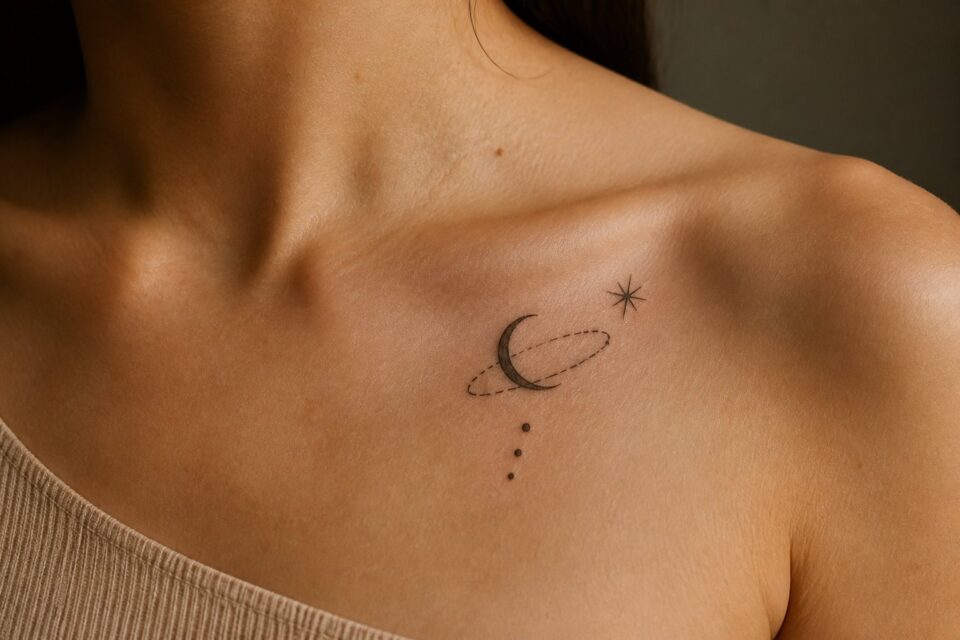

A protection tattoo may refer to a person who made you feel safe, a boundary you learned to keep, an object carried through uncertainty, or a spiritual tradition that belongs to your life. These meanings are different, and they should not be compressed into a list of supposedly universal protective symbols.
Name the protection you mean
Complete the sentence “This tattoo reminds me to protect…” The answer may be rest, family, attention, independence, memory, a place, or a part of yourself. Then describe whether protection feels like enclosure, warning, guidance, shelter, strength, or companionship.
Look for personal references before researching icons. A door latch, roofline, inherited object, repeated gesture, piece of clothing, or landscape boundary may carry more context than a symbol borrowed from a tradition you do not know.
Build the protection idea from your own night sky
A crescent above a home outline, one star copied from a family doodle, or an orbit enclosing a private mark can hold a personal sense of safety without claiming an inherited spiritual meaning. The enclosing shape should come from the story. It might be the window where you waited for someone, the direction used to find home, or the moon phase from a night when you finally felt secure.
Ways it could look beyond a generic emblem
Boundary
An open or closed circle, line around a mark, gate, wall fragment, or interrupted frame can represent limits. The design can show protection without suggesting isolation.
Shelter
A roof, window, nest-like form, folded shape, or plant canopy can refer to a real place or person associated with safety.
Guardian
An animal, tool, or object may carry a protective role, but use a species or item connected with your story. Avoid assigning a culture’s sacred guardian meaning to a decorative image without understanding it.
Direction
A compass point, light, path, or star can represent guidance through uncertainty. A real orientation, place, or remembered route can make the idea specific.
Research cultural and spiritual context
Protective imagery is often rooted in living religious, Indigenous, ceremonial, or regional traditions. Identify the origin, current meaning, and who uses the symbol. Do not rely on product descriptions or symbol-list websites as authority.
If a tradition belongs to you, record the specific family or community context. If it does not, choose personal material or a newly developed abstract system instead of lifting a sacred sign for atmosphere.
Prepare a respectful brief
- What is being protected and why it matters now
- Whether the form should enclose, guide, shelter, or warn
- Personal objects, places, or documents available as sources
- Any cultural context already researched
- Preferred visibility and relationship to the body
- Freedom for the artist to create an original composition
Protection can be expressed through a boundary you chose, a shelter you remember, or a sign you create with an artist. It does not require borrowing a symbol whose history is not yours.
Research the source before borrowing the shape
A symbol described as “protection” may come from a religion, community, story, or modern design trend, and those origins are not interchangeable. Save the page or book where you found it, note the name used there, and look for information from a museum, cultural institution, practitioner, or scholar connected to that tradition.
Do not rely on a chart that gives every symbol a one-line meaning. Ask whether the form has rules, whether it is normally worn or displayed in a particular way, and whether combining it with other imagery changes the message. If reliable sources disagree, keep that uncertainty in your notes instead of choosing the neatest answer.
You can also build a personal protection tattoo without borrowing a formal emblem. Think about the place, person, object, habit, or phrase that has made you feel safe in real life. A familiar key, porch light, plant, tool, or route can carry the idea in a way that is specific to you.
Define what protection does in your life
Protection may mean setting a boundary, remembering a safe person, carrying a home reference, staying alert, or creating calm. Write the action before selecting a symbol. A protective enclosure fits a different need from a guiding light or a reminder to leave.
Ask whether the tattoo is meant to feel guarded, comforting, watchful, defiant, or private. Those qualities guide shape and placement even when the final design is abstract.
Look for protection in personal objects
A door latch, family key, stitched pocket, blanket pattern, porch light, roofline, or hand gesture can hold protection without borrowing a sacred emblem. Photograph the object and note what it protected or made possible. Wear, damage, and repair may be the most meaningful visual traits.
Natural sources can also work: a shell, thorn, nest, curled leaf, bark, or animal posture. Avoid assigning human symbolism to a species as fact. Use the observable structure and your own association.
Run a context check on named symbols
If the idea comes with a specific religious, ceremonial, Indigenous, occult, or cultural name, pause before adapting it. Find sources from the community or institution connected to it. Learn whether it is decorative, devotional, restricted, protective only in a particular practice, or commonly misrepresented online.
Changing the line style does not erase context. If the relationship is unclear, choose the underlying action instead: shelter, boundary, direction, witness, or return. An original form can express that need without claiming a tradition.
Use boundary as composition
An open circle, nested shape, gate, frame, knot, or line around a personal mark can create visual protection. Decide whether the boundary is sealed, permeable, broken, or expanding. The difference can carry the story.
Let the centre remain quiet
The protected element does not need to be another complex symbol. It could be a dot, initial, negative-space opening, tiny plant, or nothing at all. Empty space can represent the self, a private name, or room deliberately kept free.
Choose placement by function
A visible wrist or forearm mark can act as a reminder before entering difficult spaces. A sternum, rib, shoulder, or upper-leg piece can feel like a private boundary. A design facing outward may feel watchful; one oriented toward you may feel reassuring.
Do not rely on a placement to provide literal safety. The tattoo is a symbol or reminder, not protective equipment, medical care, or a substitute for practical support. Keeping that distinction clear prevents the design from carrying an impossible promise.
Avoid the copied talisman problem
Repeated protective symbols are often circulated without their source, artist, or context. Do not send a screenshot and ask for the same mark with one line changed. Bring the story, source object, action, and shape qualities to an artist whose portfolio suits the direction.
If you want lettering, verify the language and spelling with a qualified speaker rather than a decorative font image. Decide whether the words are meant as private instruction, prayer, quotation, or general statement and handle attribution accordingly.
End with one honest sentence
Complete: “This tattoo will remind me that I can _____.” Add the personal source, desired boundary quality, placement thoughts, and any context you have researched. That sentence gives the artist a function to translate without requiring a symbol that claims universal power.
The result may be bold or quiet, ancient-looking or contemporary. What matters is that its source is understood, its cultural context is respected, and the protection it represents is something you can name in your own life.
Keep a source log for every unfamiliar mark
Write the mark’s name, where you found it, the source’s author or institution, the claimed meaning, and what remains uncertain. If five unsourced shops repeat the same sentence, that is repetition rather than verification. Look for community, museum, religious, or scholarly material connected to the tradition itself.
Share the log with the artist when context affects the design. It may lead to a more appropriate subject or to a wholly personal boundary form. Research is useful even when its conclusion is to leave a borrowed emblem alone.
Notice commercial pages that sell a symbol while making grand claims about its ancient power without naming a tradition or source. Do not use sales repetition as cultural evidence. Follow the mark back through credible collections, practitioners, or texts, and record when you cannot.
If uncertainty remains, explain the underlying need without the emblem. An artist can build protection through enclosure, posture, direction, or a personal object. The new form may be quieter, but it will have a source you can stand behind.
Review the final drawing one last time for elements added only to make it look mystical: stray runes, decorative characters, unexplained eyes, or geometry named after a tradition you did not research. Remove what has no honest role. Visual strength can come from proportion and contrast without a borrowed claim.
Keep the researched source list with the approved drawing so the meaning remains traceable after the mood board and browser tabs are gone.