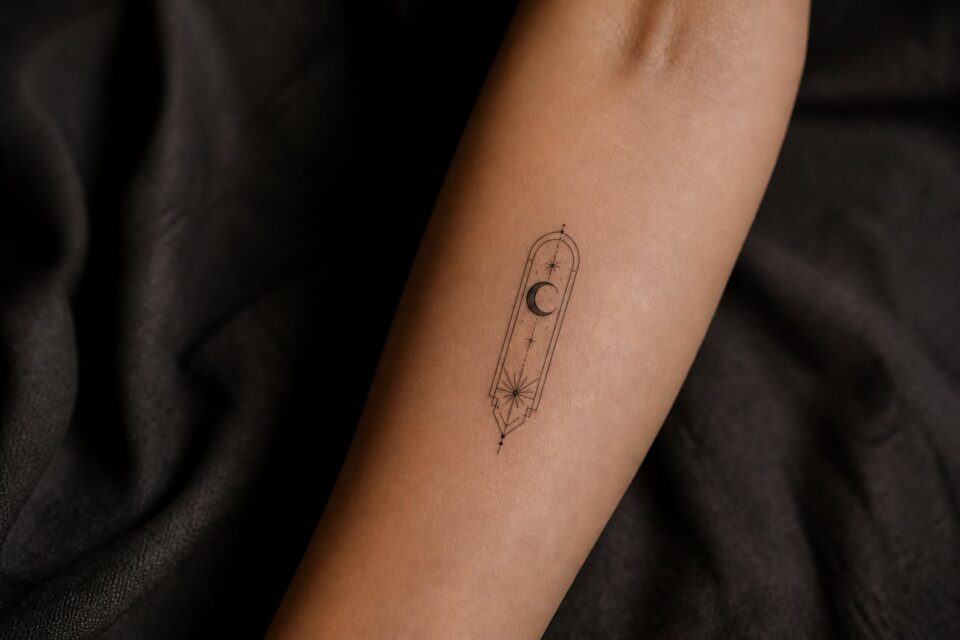
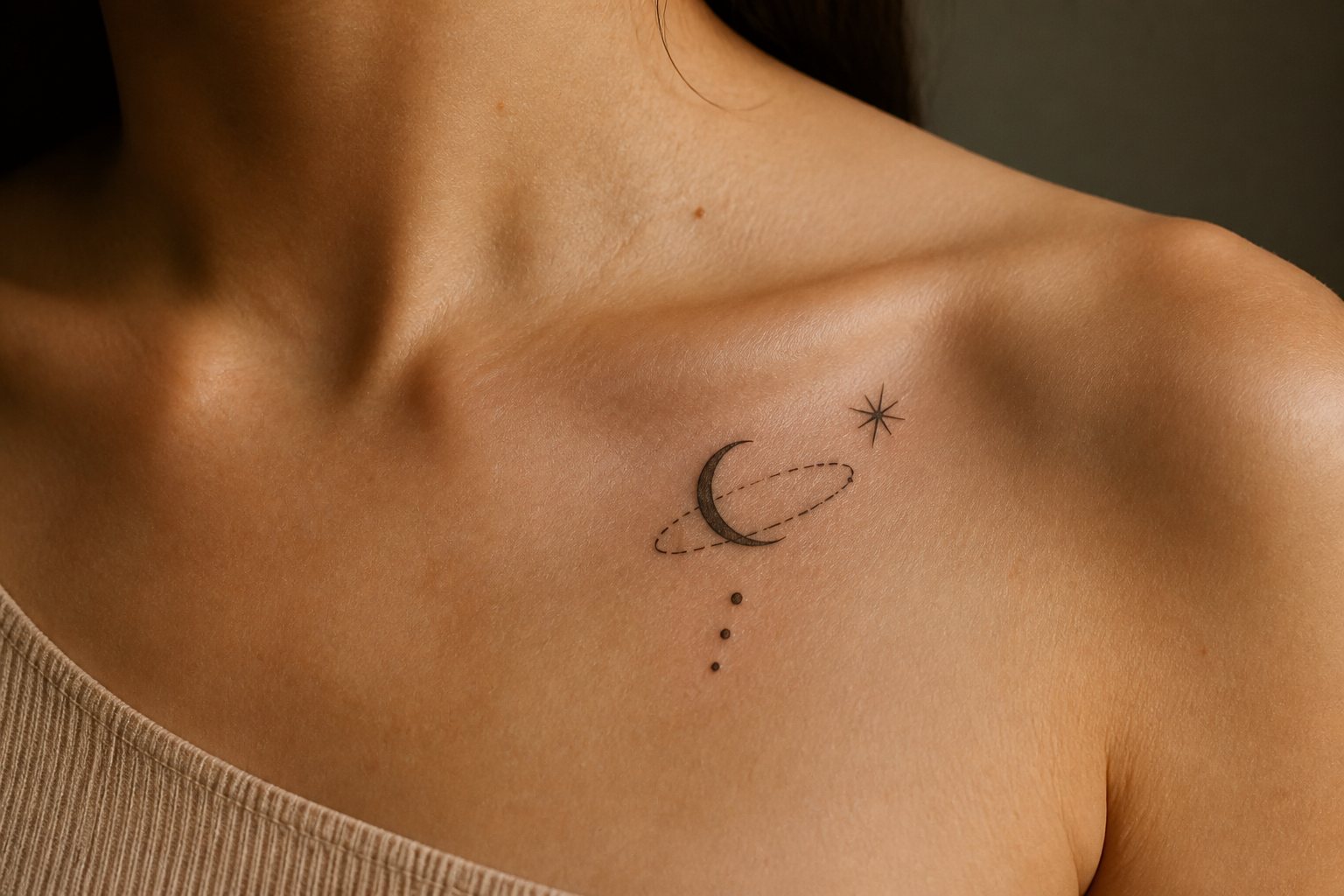
Moons and stars are among the most familiar small tattoo subjects. Their familiarity is not a reason to avoid them; it is a reason to be precise. Phase, number, spacing, orientation, and connection to a real place or date can completely change what a celestial design holds.
What a moon can represent
A crescent may suggest becoming, return, or a small amount of light. A full moon can feel complete, exposed, cyclical, or connected to a remembered night. A sequence of phases may represent change, but it can also record patience, repetition, or time measured differently.
Do not assume a phase has one fixed meaning. Ask why that form belongs to your story. Perhaps the moon was visible during a move, appears in a family phrase, or simply became a steady object during an uncertain period.
What a star can represent
A single star may act as a point of orientation, a private “you are here,” or a reference to someone associated with a particular sky. Several stars can hold a count, relationship, route, or constellation, but the arrangement should be chosen intentionally.
A compass star, hand-drawn star, four-point glint, and astronomical star map have different visual languages. Bring references that separate those qualities instead of asking for a generic “tiny star.”
Check the moon phase before drawing it
If a date matters, verify the phase instead of guessing from memory. NASA’s moon phase guide explains the cycle and links to current viewing tools. Bring the date, location, and the part of the sky you remember to the consultation. The tattoo does not need to reproduce an astronomy chart, but an accurate starting point gives the artist a real crescent angle, relationship between points, and reason for the spacing.
Use a real sky without forcing literal accuracy
If a date and place matter, a sky map can be research material. Record the source and let the artist decide how much information can be translated clearly at the intended size. A design may preserve only the relative rhythm of a few points, not every astronomical detail.
Other personal directions include the moon shape from a child’s drawing, the view through a familiar window, a star pattern from fabric or jewelry, or a celestial word in someone’s handwriting. These sources add authorship and context.
Questions about number and spacing
- Does the number of stars refer to people, years, places, or nothing literal?
- Should the elements feel connected, scattered, aligned, or orbiting?
- Is asymmetry part of the meaning?
- Will the composition follow the body or sit as a self-contained mark?
Build a sky reference packet that an artist can use
Start with one page rather than a large mood board. Put the date, location, and reason the sky matters at the top. Add one accurate moon reference, a simple diagram of the star spacing you care about, and a photograph of the body area. If you remember a view through a window, from a beach, or above a roofline, include that frame on a separate line. It can guide the composition without becoming a detailed landscape.
Label what is fixed and what is open. The moon phase may be fixed because it belongs to a date. The number of stars may be fixed because it refers to people. Their exact size, line weight, and relationship to the body can remain open for the artist. This distinction prevents the brief from becoming a tiny astronomy diagram that leaves no room for drawing.
Print the proposed marks at real size. A crescent that looks generous on a screen may become a narrow sliver on paper. Several stars may read as a dotted line when viewed from normal distance. Circle the feature you would miss most if the design were simplified, then ask the artist to build around it.
Prepare a celestial tattoo brief
State the story first, then describe the celestial material. Include the specific phase or star form, the reason for the count, preferred mood, placement, and the reference quality you value. If cultural or spiritual symbolism is involved, research that context without treating it as decoration.
Ask the artist what details will remain legible and which can be reduced. The final design should interpret your sky, not reproduce a tattoo discovered during research.
Choose a real sky, story, or viewing angle
Moon and star tattoos become more personal when the arrangement comes from something specific. It could be the phase of the moon on a remembered night, the view from a bedroom window, a constellation connected to a place, or simply the way one bright star appeared beside the moon during a trip.
Sketch the relationship before decorating it. Is the moon above the star, carrying it, circling it, or separated by a large patch of open skin? That spacing often says more than adding extra dots and sparkles. Keep a version with only the essential shapes so you can see whether the idea works without ornament.
If astronomical accuracy matters to you, record the date, place, and direction and use a reliable sky chart as a reference. If it does not, say so clearly. The artist can then focus on balance rather than trying to reconcile a symbolic arrangement with a literal one. Either choice works when it is deliberate.
Begin with observation before symbolism
Write down what you actually notice about the night sky. Maybe the moon is a reliable object during late walks, a star was visible from a hospital window, or a family member always pointed out one constellation. These observations are already meaningful. They do not need an online dictionary to certify them.
If the tattoo refers to a date, record the location and time as accurately as you can, but decide whether astronomical precision is essential. A real sky can be source material without becoming a technical chart. Often the relationship among three or four points will translate better than a dense field of every visible star.
Choose a moon phase for a reason you can state
A crescent offers open space and direction. A half moon creates a strong division. A full moon can hold texture, a face, or a clean disk. A sequence of phases introduces time and repetition. Any of these can represent change, but the chosen phase should connect to your memory, preferred shape, or composition rather than a fixed universal meaning.
Orientation matters. A crescent opening left, right, upward, or downward has a different balance, and the body may change how that opening reads. Test paper shapes near the placement. What looks elegant on a square mood board may feel tipped when it follows a shoulder or forearm.
Give the star count an honest job
One star can act as a point of orientation. Several can represent people, places, chapters, or simply make a pleasing rhythm. Do not assign meaning after the design is finished just because every count is expected to stand for something. If a number is personal, tell the artist it is fixed. If not, let spacing and anatomy guide it.
Stars have different drawing languages
A five-point outline, hand-drawn asterisk, four-point glint, nautical star, and plotted astronomical point do not say the same thing visually. Collect examples of the form rather than entire tattoos. If cultural, navigational, or religious context is part of the choice, research it directly and explain what relationship you have to it.
Sources that make a celestial design personal
- A photograph of the horizon from a meaningful place.
- The moon as drawn by a child or relative.
- A window shape that repeatedly framed the sky.
- Coordinates or a route used only as construction material.
- A piece of jewellery with a family history.
- The spacing of lights seen on a particular journey.
- A date written in the hand of the person connected to the memory.
Limit the artist packet to the sources that affect the drawing. A large folder of general “celestial vibes” can make the idea less clear. Label whether each item contributes shape, arrangement, texture, mood, or story.
Balance delicacy with enough contrast
Tiny stars scattered over a large area may photograph softly but disappear in ordinary viewing. A very small moon filled with craters may become visually busy. Ask the artist to show the composition at actual size and to identify which marks carry the silhouette. A mix of open skin, one stronger form, and a few quieter points can feel more delicate than making every line equally faint.
If you want colour, decide whether it has factual, emotional, or purely visual importance. Night-sky blue, warm gold, and black each change the mood. Review the artist’s healed colour work and discuss how the selected palette behaves at the proposed scale.
Choose placement by the way the sky moves
A compact moon-and-star emblem can sit on a wrist, ankle, shoulder blade, or upper arm. A trail of points may follow a collarbone, forearm, rib, or spine. A phase sequence needs enough length and spacing to remain readable. Stencil the whole arrangement and move normally before approving it.
Think about whether you want to see the moon in its “upright” orientation yourself or present it that way to someone facing you. Discuss the choice rather than applying a blanket rule. The body has no single flat front, and a celestial piece often benefits from responding to that fact.
Remove one thing before you finish the brief
Celestial designs easily accumulate clouds, sparkles, zodiac signs, dates, flowers, and lettering. Take away the least necessary element and see whether the story becomes clearer. The sky feels expansive partly because of the distance between objects. Let the tattoo keep some of that room.
Send the artist the remembered sky, the fixed celestial details, the reason for the count or phase, preferred body area, and the mood you want. The strongest version will not prove that moons and stars have one meaning. It will show why this arrangement belongs to one woman’s particular night.
Keep the astronomical record separate from the artwork
If you use a sky chart, save the date, time zone, location, tool, and original output in your private archive. Give the artist a marked copy showing only the points that matter. This protects factual context without expecting a tattoo to function as a complete scientific diagram.
Decide what may move for composition. A fixed constellation shape, a meaningful moon phase, and the body’s curve may not fit together exactly at small scale. Rank them. The artist can preserve the relationship you value most and simplify the rest openly, while the full chart remains available whenever you want to revisit the actual sky.