
Geometric tattoos are often discussed as if every circle means wholeness and every triangle has one fixed message. Geometry is more useful as a visual language: enclosure, repetition, direction, balance, interruption, measurement, and relationship between parts.
Start with the behaviour of the shape
A circle can enclose, connect, repeat, or remain open. A line can divide, measure, guide, or stop. A grid can organize information or show where order breaks. Ask what the form is doing before assigning it a meaning.
The relationship between shapes may carry more story than the shapes themselves. Two points separated by a line, an orbit around an off-center mark, or a pattern interrupted once can describe distance, attention, protection, or change.
Choose what geometry changes and what stays organic
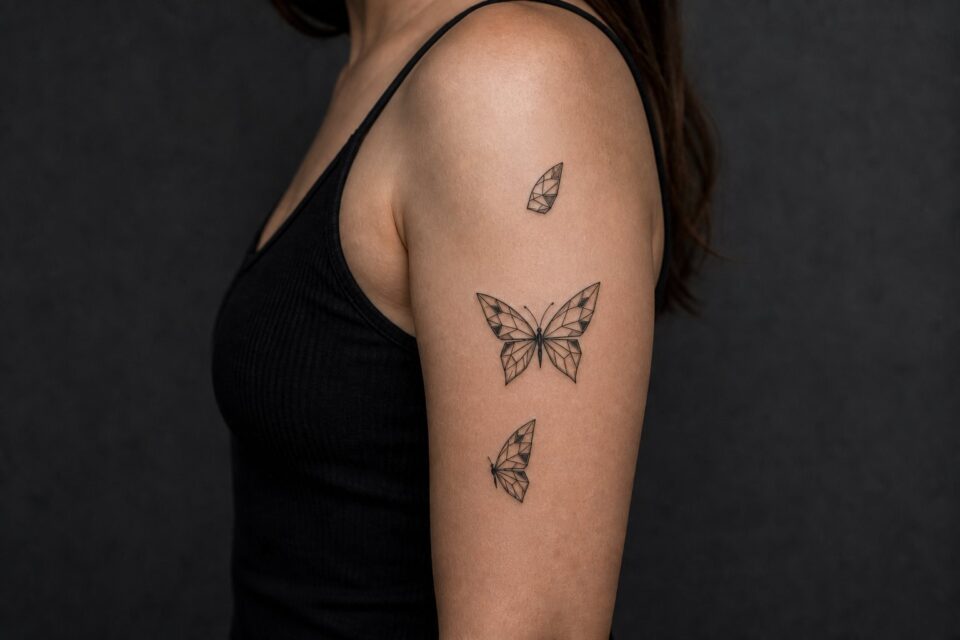
You might keep the butterfly’s outer wing contour natural while reducing the interior to measured bands. Another design could use one geometric wing and one lightly observed wing, but the difference needs a reason beyond visual novelty. Decide whether the rule concerns symmetry, repeated angles, interruption, or proportion. One rule is enough. Too many grids and circles can bury the butterfly that gave the idea its meaning.
Ways to build personal meaning
Use meaningful proportion
A count, interval, date, route, or relationship can determine spacing and repetition without displaying the information literally.
Translate an object
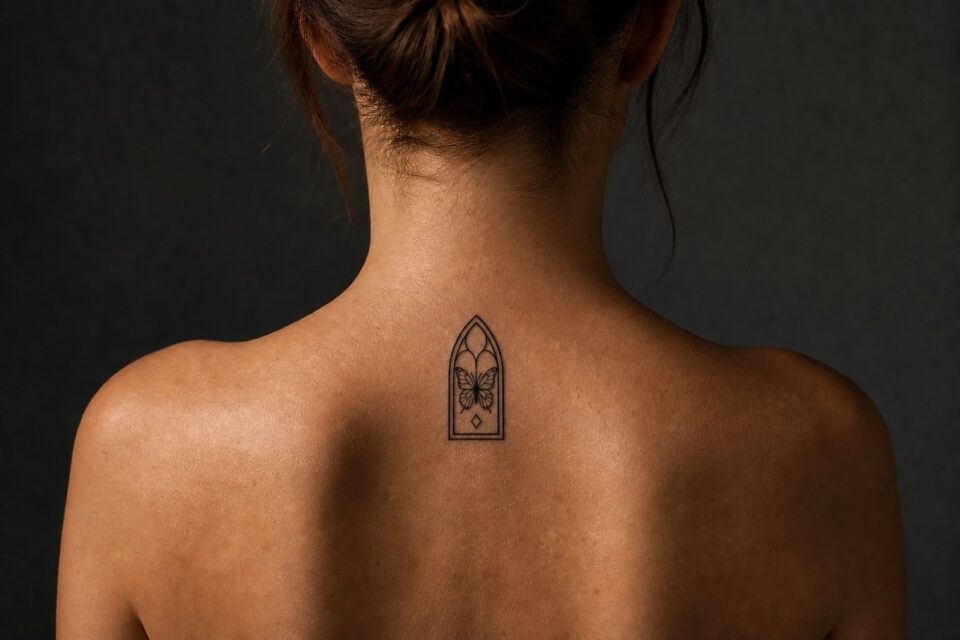
A window, tile, tool, architectural detail, textile, or map can be reduced to its underlying geometry. Use source images you own or have permission to share.
Map a relationship
Points can represent people or places; lines can show routes or connection. Avoid presenting a generic constellation as personally exact if the arrangement is invented.
Create a private system
Work with the artist to assign visual rules: one break for a transition, repeated marks for years, or a changed angle for a decision. The system only needs to be coherent for the design.
Decide whether precision is the point
Hand-drawn irregularity, offset alignment, an open edge, or one altered unit can make the meaning visible. A geometric tattoo does not have to imitate machine perfection. Describe whether you want technical, organic, architectural, playful, or weathered geometry.
Cultural and spiritual geometric traditions require context. Research the source, avoid treating sacred patterns as neutral decoration, and ask the artist about their experience with the material.
Prepare an original geometric brief
- The story or relationship the system should hold
- The action of the form: enclose, connect, repeat, divide, or open
- Any meaningful counts, ratios, directions, or interruptions
- Preferred degree of precision or irregularity
- Placement and whether the body should change the geometry
- References labelled by structure, not copied composition
A geometric tattoo becomes personal when its rules come from your material and the artist’s interpretation,not from a chart that assigns permanent meanings to basic shapes.
Give the geometry one clear rule
Before adding more shapes, decide what the design is allowed to do. It might be perfectly mirrored, built from repeating angles, or intentionally offset around one central form. A simple rule gives the eye something to follow and makes later choices easier.
Take every element in the sketch and ask whether it supports that rule. A circle can soften a field of sharp angles. A second circle added only to fill space may weaken the composition. The same test applies to dots, tiny rays, and ornamental borders. Decoration works best when it reinforces the structure instead of hiding it.
- Choose symmetry or controlled imbalance.
- Decide whether shapes overlap or keep a consistent gap.
- Limit line weights before adding fine accents.
- Check that the center still reads at the intended size.
Placement can become part of the rule too. A long design may align with the forearm, shin, or spine. A radial design may make more sense on the shoulder or knee area. Ask the artist to show how the geometry changes when the stencil sits on a curved surface. A mathematically tidy screen image can feel very different once it wraps around the body.
Start with the source of the geometry
Geometry can come from architecture, weaving, maps, tools, natural structures, diagrams, or pure abstraction. Naming the source changes the brief. A pattern derived from a family tile is not the same project as a balanced set of invented lines. Photograph the source straight on and from context so the artist knows what is personal.
If the motif belongs to a living cultural or religious tradition, research its use before treating it as decoration. Ask what it signifies, who uses it, and whether your relationship to it is respectful. Visual attraction alone does not remove context.
Define the rule behind the shape
A strong geometric tattoo usually follows a system: repetition, rotation, reflection, proportion, tessellation, or one deliberate break. Write the rule in plain language. “Three unequal circles sharing one point” gives the artist more information than “sacred geometry style.”
Decide whether precision or evidence of the hand matters. Perfectly regular forms feel engineered; slight variation can feel drawn, textile-like, or organic. Neither is superior, but the artist’s portfolio should show the quality you expect.
Use one disruption rather than many decorations
An open corner, shifted line, missing segment, or change in spacing can hold the personal meaning. The interruption may refer to a move, a person, or a choice. When every edge has a special alteration, the system becomes harder to see and the meaningful break loses emphasis.
Let negative space count as a shape
The empty centre of a knot, the gap between parallel lines, or an unfilled wedge can be the main form. Ask the artist to test whether that space remains clear at the proposed size. Small geometric work can become dense when gaps are treated as leftover room.
Plan for a curved, moving surface
A circle on a forearm will not appear circular from every angle. Parallel lines on a shoulder change as the arm moves. Decide which view is primary, then accept that the tattoo belongs to a body rather than a printed diagram. An experienced artist can place the stencil so the intended system reads in neutral posture.
For wraps and bands, view the full circumference. The joining point, changing limb width, and relationship to joints need design decisions. A partial band or open structure may preserve the geometry better than forcing a continuous loop.
Read a precision portfolio carefully
Look for healed straight lines, repeated spacing, circles, and joins at the scale you want. Notice whether photographs show enough body to understand placement. Extreme edits or only fresh close-ups make assessment difficult, so ask for additional healed work if needed.
Precision is also a design skill. Check how the artist handles endings, intersections, and optical balance. Mathematically equal spacing does not always look equal on a curved surface; thoughtful adjustment can be more convincing than rigid measurement.
Prototype the pattern at several sizes
Print the design and shade the smallest gaps with a pencil. If the system disappears when one gap closes visually, consider enlarging or reducing the number of repeats. A compact mark with three clear units often communicates better than nine tiny units copied from a larger reference.
View the prototype at arm’s length and in a full-body mirror. Geometry can feel much heavier on the body than on a white screen because solid black and repeated lines create visual weight. Adjust scale and open skin together.
End the brief with fixed and flexible rules
List the source, the governing rule, meaningful count or break, preferred placement, scale range, and degree of precision. Then state what the artist may change: spacing, orientation, number of secondary units, or line weight. This prevents a personal system from being lost while giving the composition room to fit you.
A geometric tattoo need not be cryptic or spiritually inflated. It can simply be a well-made visual rule connected to a real object, place, or decision. Clarity about that source is what keeps an abstract mark from becoming interchangeable.
Create an error-proof approval copy
On the final concept, label fixed counts, intentional gaps, symmetry axes, and the one deliberate irregularity. Verify numbers yourself. A repeated pattern can hide an accidental missing unit, and a meaningful count is easy to misread when several lines cross.
Then remove the labels and judge the composition normally. The technical diagram protects the rule; the clean view protects the tattoo as an image. Bring both to the appointment if the studio’s process allows. This keeps mathematical intent clear without asking the artist to tattoo construction notes or force the body into a perfect grid.
Check the design in a mirror because reflection can expose accidental imbalance that the eye stopped noticing during construction. If handedness or direction has meaning, label the approved version so it is not casually flipped. A symmetrical design may tolerate reversal; a map-derived angle or character may not.
Finally, ask whether the rule is visible without an explanation. It does not have to be, but knowing the answer helps you choose between a private coded system and a geometric image meant to read immediately.