
A friendship tattoo can honour years of history without turning that history into identical clip art. The most durable ideas often come from details that would look ordinary to anyone else: the table where you met, the weather on a repeated trip, a badly drawn map, or the punctuation in a message that always made both of you laugh.
Gather material together and separately
Each person should list places, objects, phrases, rituals, turning points, and contrasts connected with the friendship. Do this separately first. When you compare lists, repeated details reveal the shared center; different details show how each person experiences it.
Photographs from your own archive are especially useful. Look beyond faces to backgrounds, objects, signs, ticket shapes, landscapes, and colors. These can become visual evidence without asking an artist to copy another tattoo.
Choose how the tattoos relate
Parallel
The same visual rule is applied to different subjects. Two local plants, two favorite objects, or two weather marks can share treatment while remaining individual.
Complementary
The subjects belong to one action or scene: cup and spoon, key and door, shore and wave, question and reply. Each should still read as a complete design on its own.
Sequential
Two marks represent different points on the same route or timeline. Avoid making the sequence so literal that future change makes one tattoo feel incomplete.
Privately coded
A number, coordinate, page reference, abstract sign, or edited phrase can hold meaning without explaining the relationship publicly.
Build the pair from a place you both know
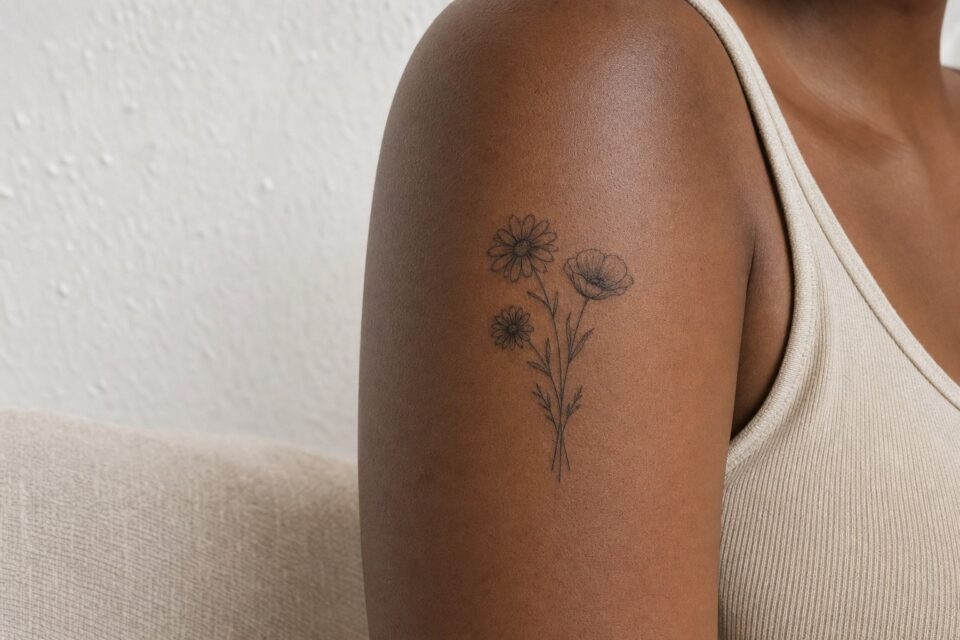
A friendship botanical can come from the weed beside a first apartment, flowers on a repeated walk, herbs used during shared dinners, or a tree that appears in years of photographs. Each friend can choose a different detail from the same source. Keep one connection, such as line weight or stem direction, then let scale and placement follow the person wearing it. The result will still relate when the tattoos are seen separately.
Twelve prompts that leave room for interpretation
- Two views of the same landmark
- Objects carried on a first trip
- Different plants from one place
- A route reduced to two turns
- Paired punctuation from a message
- Contrasting weather symbols
- A shared snack drawn as separate ingredients
- Two tools from a hobby
- A phrase split by personal relevance
- Two abstract marks with one repeated angle
- Different phases of one natural cycle
- A drawing rule invented with the artist
Build one shared brief and two personal notes
The shared brief explains the story, fixed visual connection, artist preferences, and intended timing. Each personal note covers placement, scale, visibility, and style. Discuss budget and scheduling directly with the artist or studio without assuming two appointments will follow the same process.
Choose an artist whose portfolio supports the look and feel, then give them enough freedom to create a pair that belongs to your friendship, not the search results.
Use one shared story without matching exactly
Friendship tattoos become easier to design when you stop looking for a universal symbol of friendship. Pick one story that only the two of you would tell the same way. It might be a missed train, a terrible recipe you kept making, a concert ticket, or the shape of a place where you spent time together.
Write down the nouns in that story and sketch several ways to divide them. One person might wear the object while the other wears its shadow, route, sound, or date. You can also keep the same outline but change one internal detail. That creates a visible connection without making either person wear a design that does not suit them.
Before booking, agree on what happens if one person later wants a different size or placement. A friendship is not weakened by two tattoos that are related rather than identical. In fact, letting each person make a few honest choices usually gives the pair more character.
Do friendship fieldwork for a week
Instead of choosing a symbol during one excited conversation, collect details for seven days. Save voice-note phrases, photographs of familiar meeting places, recurring objects, food orders, route shapes, weather memories, and tiny habits. Ask each friend to gather independently. The material that appears on both lists is shared; the unexpected material is often where personality enters.
Do not dismiss silly references. The chipped mug, terrible umbrella, or misspelled sign from a trip may carry years of recognition. Humour can make a tattoo emotionally durable when it comes from a real source rather than a novelty graphic.
Choose how obvious the connection should be
Some pairs want strangers to recognise a set. Others prefer a private link. Place the idea on a spectrum from identical to invisibly related. Possible connections include subject, colour, line rhythm, shape, scale, artist, placement, or date. Pick one or two. Repeating everything can flatten the two people involved.
For a private connection, each tattoo might include the same small angle taken from a map, a number of marks, or a gap in the same position. These are visually complete without explanation and become meaningful when the source is known.
Make every tattoo complete on its own
Split images can be fun for a posed photograph but spend most of their lives apart. Ask whether each half still looks intentional alone. If not, an artist can create two complete subjects that interact when placed together, or two objects from the same action.
Complete does not mean complicated. A cup and a spoon, two different leaves from one park, separate punctuation marks from one message, or opposite turns in a route can each stand alone. The story supplies the connection.
Protect different taste and comfort levels
One friend may want colour and the other black ink. One may love a visible wrist tattoo while the other needs coverage. Hold the source constant and let treatment vary. Forcing a compromise style can produce two designs nobody fully wants.
It is also fine for only one person to get tattooed. The friendship is not weakened because bodies, health considerations, budgets, or preferences differ. A shared design session could result in a tattoo for one person and a print, drawing, or kept sketch for the other.
Agree on boundaries before booking
- Either person may postpone or stop without defending the friendship.
- Each controls her own placement and scale.
- Budget limits are discussed plainly.
- The artist is not asked to trace a pair found online.
- Public posting happens only with everyone’s consent.
Search for the artist through the visual problem
Describe what the pair needs: two loose botanical studies, small graphic objects, readable lettering, or complementary abstract marks. Then find healed examples in portfolios. Popularity in matching-tattoo searches is less relevant than the artist’s ability to draw the actual subjects and scale.
Send personal source material first. If you include other tattoos, label only the quality you like and credit the artist when possible. State that you want an original pair. A good brief gives enough context to invent without dictating the finished composition.
Use the ordinary-distance test
Print the proposed designs at size and view them from across a small room. Do they remain clear, or do they rely on a macro photograph? Then place them near the chosen body areas and take unposed pictures in normal light. The test often reveals that a little more scale or open space will make the set feel calmer.
The result does not have to summarise an entire friendship. Choose one true detail and let it carry the years around it. A pair made from careful source material will still feel connected when the trend cycle, the group photograph, and even the frequency of contact have changed.
Design for friends who do not live in one place
If appointments happen in different cities, decide whether one artist will draw both pieces, whether a licensed design can travel, or whether two artists will interpret a shared source independently. Do not pass one artist’s custom drawing to another without permission. Clarify authorship before paying deposits.
Independent interpretation can become part of the concept: the same route, plant, or object seen through two local artists. Keep a common brief with the fixed source and let each person document her decisions. The pair will be connected by origin rather than forced duplication, which often suits a friendship already practiced across distance.
If the work is meant to be visually related, ask both artists before assuming they will coordinate. Share only material you have permission to share and credit every drawing. Another option is to commission one artist for two designs and book separate appointments with that same artist later. Travel inconvenience is not permission to have a custom drawing copied elsewhere.
Record the final connection in a short note: same source, two crops; same count, different subjects; or same frame, different hands. Years later, that note will make the relationship clear even if the design link is subtle to everyone else.